
How to Read Baseball Odds: A Beginner's Complete Guide
 Available in US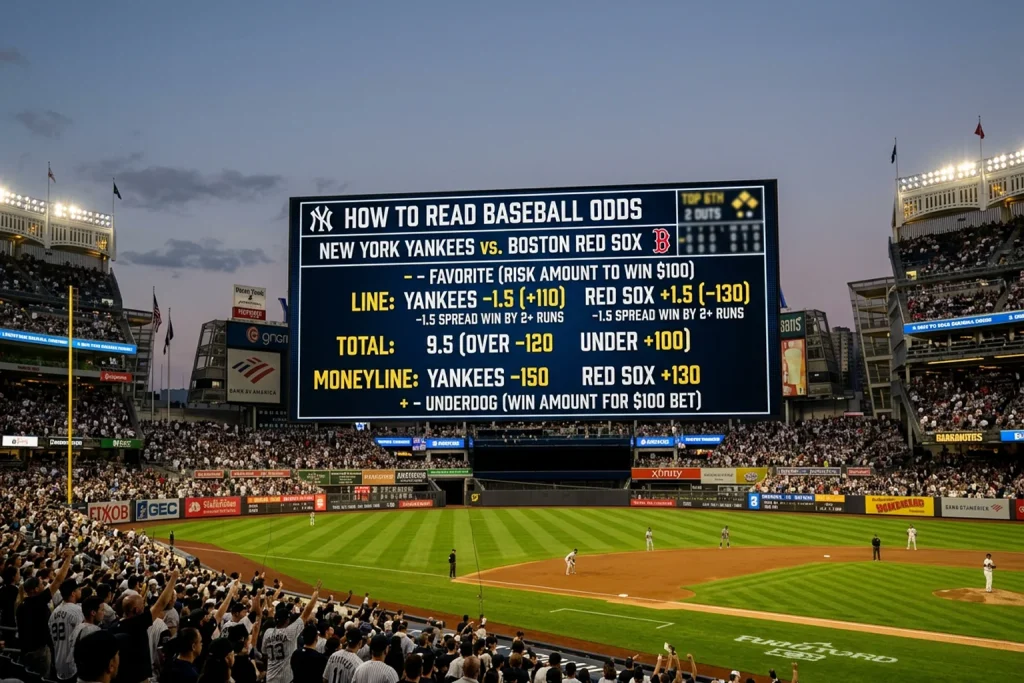
When I placed my first baseball bet in 2015, I stared at -145 and +125 for several minutes trying to figure out what it meant. The numbers seemed arbitrary, almost coded. Nobody had explained American odds to me, and I was too embarrassed to ask at the sportsbook window. Years later, I teach these concepts to new bettors regularly – and the confusion I felt is universal. Understanding odds isn’t intuitive, but it’s essential for anyone who wants to bet baseball intelligently.
Baseball odds tell you two things: how much you can win and how likely the sportsbook thinks each outcome is. Those numbers you see next to team names aren’t random – they encode probability and payout information in a format that becomes second nature with practice. This guide walks through American odds format, positive and negative numbers, payout calculations, and the concept of juice that funds sportsbook operations. Master these fundamentals before exploring advanced strategies at baseball bet of the day.
American Odds Format
American odds express payouts relative to a $100 stake. Negative numbers show how much you must risk to win $100. Positive numbers show how much you win if you risk $100. This $100 baseline makes comparison straightforward once you internalize the format. Every legal US sportsbook uses American odds as their default display.
The number magnitude indicates how favored or unfavored a team is. Small numbers close to even – say -110 or +105 – represent near-toss-up games. Large negative numbers like -250 indicate heavy favorites. Large positive numbers like +200 indicate significant underdogs. The further from even, the more one-sided the market believes the game to be.
International bettors might encounter decimal or fractional odds instead. Decimal odds show total return per $1 wagered – 2.50 means $2.50 total return ($1.50 profit plus $1 stake). Fractional odds like 5/2 mean $5 profit for every $2 wagered. Most odds conversion tools translate between formats instantly if you encounter unfamiliar displays.
Reading Positive (+) Odds
Positive odds indicate underdogs – teams the market believes are less likely to win. The number tells you profit on a $100 wager. At +150, a $100 bet returns $250 total: your original $100 plus $150 profit. At +200, that same $100 returns $300. The larger the positive number, the bigger the payout and the less likely the outcome according to the sportsbook.
Converting positive odds to implied probability uses this formula: 100 divided by (odds plus 100). For +150: 100/250 = 0.40 or 40% implied probability. For +200: 100/300 = 0.333 or 33.3% implied probability. These percentages tell you how often the sportsbook believes the underdog wins.
Positive odds don’t mean a team will lose – they mean the market prices them as less likely to win. Teams at +120 win frequently. Even +250 underdogs win often enough to be profitable if priced incorrectly. Don’t avoid positive numbers because they look like “losers.” They’re simply the less favored side, which sometimes represents the best value.
Reading Negative (-) Odds
Negative odds indicate favorites – teams the market believes are more likely to win. The number tells you how much you must risk to win $100 profit. At -150, you risk $150 to win $100 (returning $250 total). At -200, you risk $200 to win $100. The larger the negative number, the more you must invest for the same profit – reflecting higher confidence in that outcome.
Converting negative odds to implied probability: take the absolute value of the odds divided by (absolute value plus 100). For -150: 150/250 = 0.60 or 60% implied probability. For -200: 200/300 = 0.667 or 66.7% implied probability. Heavier favorites carry higher implied probabilities.
Negative odds mean you’re paying a premium for the more likely outcome. That premium can be worth paying if the team is genuinely underpriced – even at -180, if true probability is 75%, you have value. But negative odds inherently require higher accuracy to profit. A -200 bet needs to win 66.7% just to break even, leaving little room for error.
Calculating Potential Payouts
For positive odds: multiply your stake by (odds/100) to find profit. A $50 bet at +150 returns $50 x 1.50 = $75 profit, plus your $50 stake = $125 total. Scale up or down proportionally. A $25 bet at +150 returns $37.50 profit plus stake = $62.50 total.
For negative odds: divide your stake by (|odds|/100) to find profit. A $75 bet at -150 returns $75 / 1.50 = $50 profit, plus your $75 stake = $125 total. Alternatively, use the formula: stake x (100/|odds|) = profit. Both methods produce identical results.
Modern sportsbook apps calculate payouts automatically when you enter stake amounts, eliminating manual math. But understanding the underlying calculation helps you evaluate value quickly without plugging every potential bet into an app. Mental math approximations become natural with practice.
Understanding Juice (Vig)
Juice – also called vig or vigorish – represents the sportsbook’s margin on each bet. In a perfectly fair market, a 50-50 proposition would offer +100 on each side. Instead, books typically offer -110 on each side, meaning you risk $110 to win $100. That extra $10 risk on each side is the juice that funds sportsbook operations.
The standard -110/-110 line creates roughly 4.5% house edge. Converting both sides to implied probability: -110 implies 52.38%. Two sides at 52.38% totals 104.76% – the extra 4.76% is the book’s theoretical margin. The more juice, the harder it becomes to profit long-term. Shopping for better lines reduces this built-in disadvantage.
Juice varies across bet types and books. Standard sides and totals usually carry -110 standard juice. Player props might have -115 or -120 standard juice, increasing the house edge. Alternative lines and exotic bets often have higher juice because they see less action and require more risk management from books.
Reading Different Line Types
Moneyline odds tell you who the market favors outright. Run line odds show favorites giving or getting 1.5 runs with adjusted prices. Total lines display over/under numbers with odds on each side. Each line type uses the same American odds format – only the underlying bet differs.
A typical baseball line might display: Team A -145 / Team B +125 (moneyline), Team A -1.5 (+140) / Team B +1.5 (-160) (run line), Over 8.5 -110 / Under 8.5 -110 (total). Reading across these lines gives you a complete picture of how the market prices the game.
Props and derivatives use identical formatting. “Player X to hit a home run: +350” follows the same logic as moneyline underdogs. “Over 6.5 strikeouts for Pitcher Y: -125” uses the same calculation as totals. Once you understand the format, every bet type becomes readable.
Frequently Asked Questions
What does -150 mean in baseball betting?
A -150 line means you must risk $150 to win $100 profit. This indicates the team is a moderate favorite with approximately 60% implied probability. Your total return if the bet wins would be $250 – your $150 stake plus $100 profit.
How much do I win on +200 odds?
At +200 odds, a $100 bet returns $300 total – $200 profit plus your $100 stake. Scale proportionally for different bet sizes: a $50 bet returns $150 total ($100 profit plus stake). The +200 implies approximately 33.3% win probability.
Why are there different odds at different sportsbooks?
Sportsbooks set their own lines based on their risk exposure, sharp action they"ve received, and their assessment of true probability. These factors create variation – one book might offer -140 while another has -150 on the same team. Line shopping across multiple books helps you find the best available price.
Putting It All Together
Reading odds becomes automatic with repetition. Start by mentally converting every line you see to implied probability. Over time, you’ll intuitively recognize that -150 means “about 60%” and +150 means “about 40%” without conscious calculation. This fluency lets you evaluate value quickly as you scan each day’s games.
Apply these fundamentals to the strategies covered in MLB moneyline picks and across other bet types. Understanding odds is prerequisite knowledge – it’s not where your edge comes from, but you can’t identify or quantify edge without mastering it first. Build this foundation before moving to advanced handicapping concepts.
Articles
Created by the "Baseball Bet of the Day" editorial team.
